
Stories in Volume 19, Issue 3 — April-June 2008
 Governance
In Haifa, a global election showcases global diversityMore than 1,000 delegates from 153 countries, using a distinctive democratic electoral process, gather to elect the international governing body of the Bahá'í Faith HAIFA, Israel — For nearly three hours on 29 April 2008, more than 1,000 people from 153 countries filed... Read more |
|
Governance
With no nominations or campaigning, how does the Baha'i electoral process work?Related story: In Haifa, a global election showcases global diversity More than 1,000 delegates from 153 countries, using a distinctive democratic electoral process, gather to elect the international governing body of the Bahá'í Faith HAIFA, Israel - In a world... Read more |
|
Perspective
Perspective: Crossing the divide between science and religion: a view on evolutionMany people today question the place of religion in an age of science. This is understandable: the extraordinary success of the scientific method at providing a nearly seamless explanatory framework for the physical world has acutely challenged traditional religious beliefs... Read more |
 Women
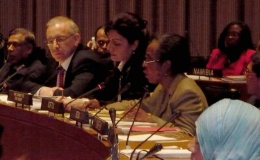
Women's equality can improve economic performance, economist tells the UNUNITED NATIONS - Equality between the sexes can have a real world economic effect, potentially improving the economic performance of nations and corporations. That was among the ideas offered by noted economist Augusto Lopez-Claros, speaking in February at the United... Read more |
 Poverty
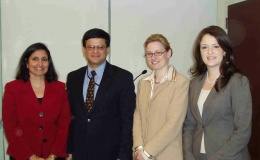
At the UN, a discussion of poverty, employment, and the meaning of workUNITED NATIONS - The Bahá'í International Community issued two statements, one on poverty and one on employment and work, and helped to organize a panel discussion on youth and employment at the UN Commission on Social Development in February. The statement on poverty, "... Read more |
 Human Rights
In Iran, new anti-Baha'i tactics come amidst surprising pockets of supportGENEVA - Last March, after being threatened twice, once by anti-Bahá'í graffiti at his workplace and then by a hate-filled letter, a 53-year-old Bahá'í businessman in Shiraz, Iran, was chained to a tree, doused with gasoline, and assaulted by an unknown assailants who threw... Read more |
|
Human Rights
In Egypt, the government decides not to appeal Baha'i decision in religious freedom casesFrom previous issues: Egypt lower court rules in favor of Bahá’ís, opening door to ID card solution CAIRO — In a victory for religious freedom, a lower administrative court has ruled in favor of the plaintiffs in two lawsuits that sought to resolve the government’s... Read more |
 Recognition
In Vietnam, a milestone for Baha'isHO CHI MINH CITY, Vietnam - The Bahá'ís of Vietnam have reached a historic milestone with the election - for the first time in many years - of a national Bahá'í administrative body. In Vietnam, the Bahá'í national convention and election held 20-21 March 2008 were the... Read more |
 Review
The "new Alexandria" and global changeWikinomics: How Mass Collaboration Changes Everything By Don Tapscott and Anthony D. Williams Portfolio New York We live in a period characterized by diversity, chaos and an intense search for solutions to increasingly complex and global problems. Within that... Read more |