
In Chile, a new House of Worship breaks architectural boundaries — and stirs a new sense of community
- In October, Bahá’ís from around the world and others came to Santiago, Chile, for a three-day ceremony commemorating the completion of the eighth Bahá’í House of Worship.
- The distinctive new religious building, inspired by “the universal form of a spiral” has drawn praise from architectural critics and others.
- Its builders hope it will spur a new sense of community cohesion and inspiration in the region.
SANTIAGO — From an architectural point of view, the recently completed Bahá’í House of Worship here is a stunning achievement, pushing both the aesthetic and technical frontiers for religious buildings in new directions.
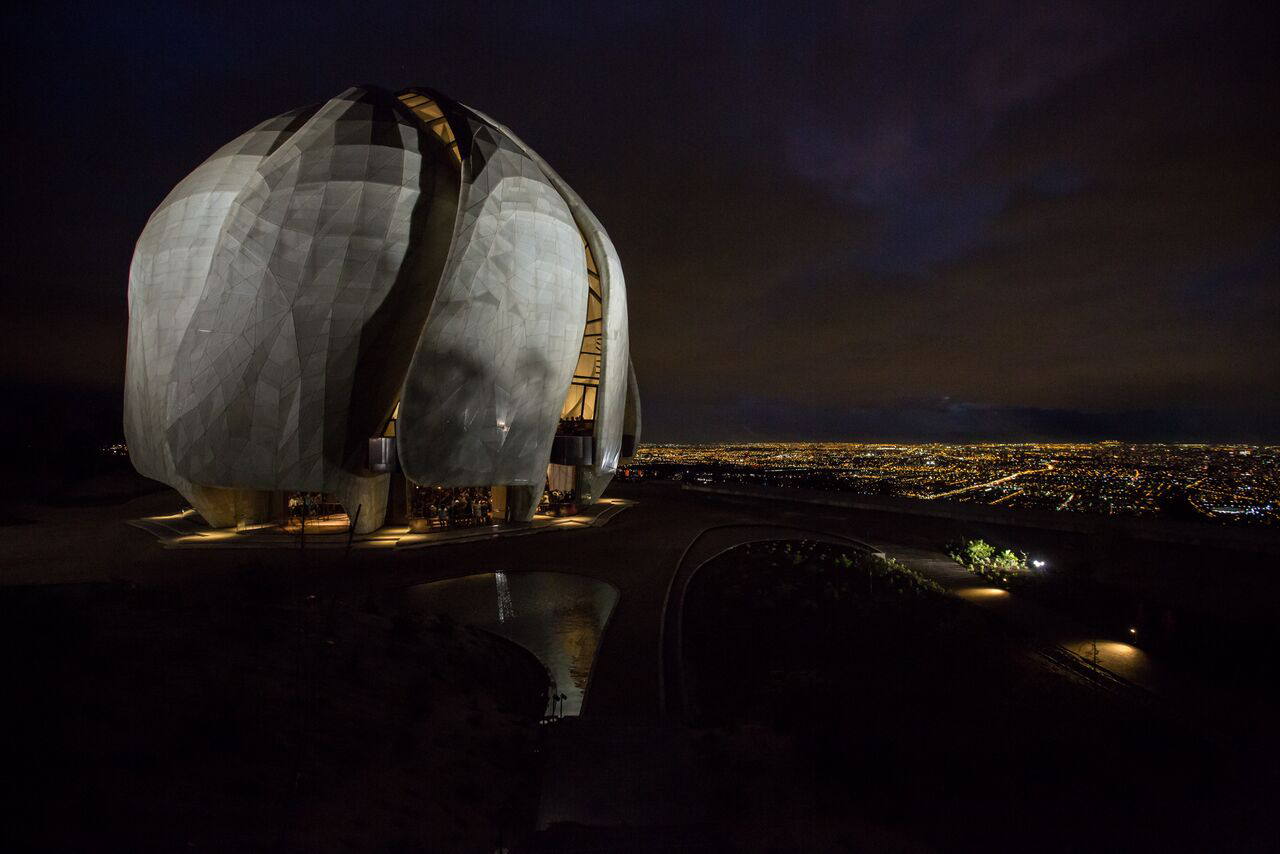
Aesthetically speaking, it is visually unique: a winding, spiraling dome of glass and white marble that, in the words of one architectural reviewer, “resembles a glorious flower, its translucent glass petals contrasting with the mountains and merging with the cloudy sky.”
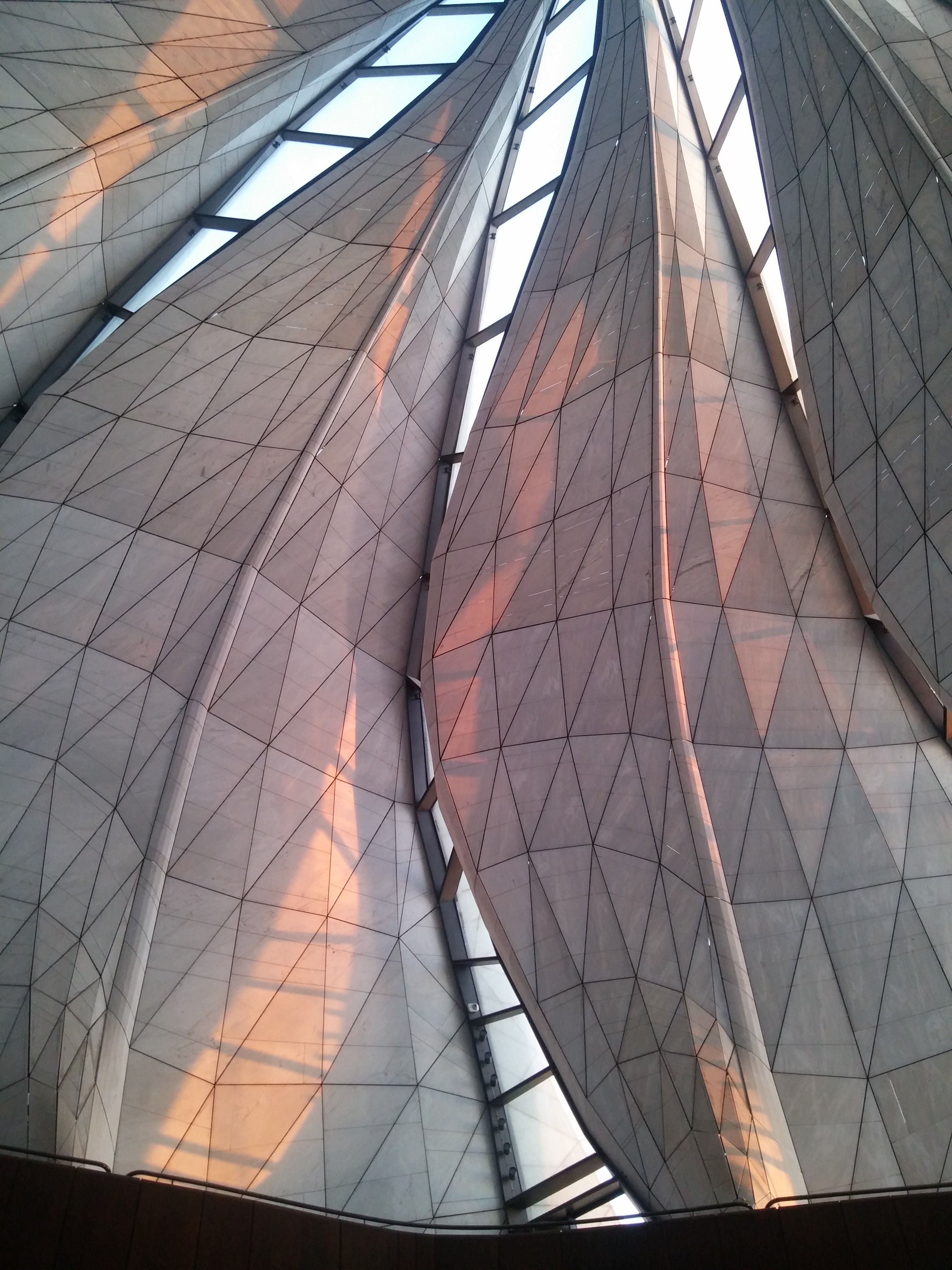
Technically, the building required the development of entirely new methods for casting curved glass cladding and affixing it to a steel skeleton. For example, the builders turned to a computer program normally used to design aircraft to work out the precise shapes of the 10,161 cast glass elements and 8,001 marble pieces that went into the spiraling “wings” of the building.
Those assembled for the Temple’s dedication here in October 2016 paid tribute to such achievements — and also took note of the building’s significant spiritual and community-building aspirations.
Minister Secretary General Nicolás Eyzaguirre, who represented Chilean President Michelle Bachelet at the dedication ceremonies, called it “a transcendental space that looks for unity and respect for all religious backgrounds.”
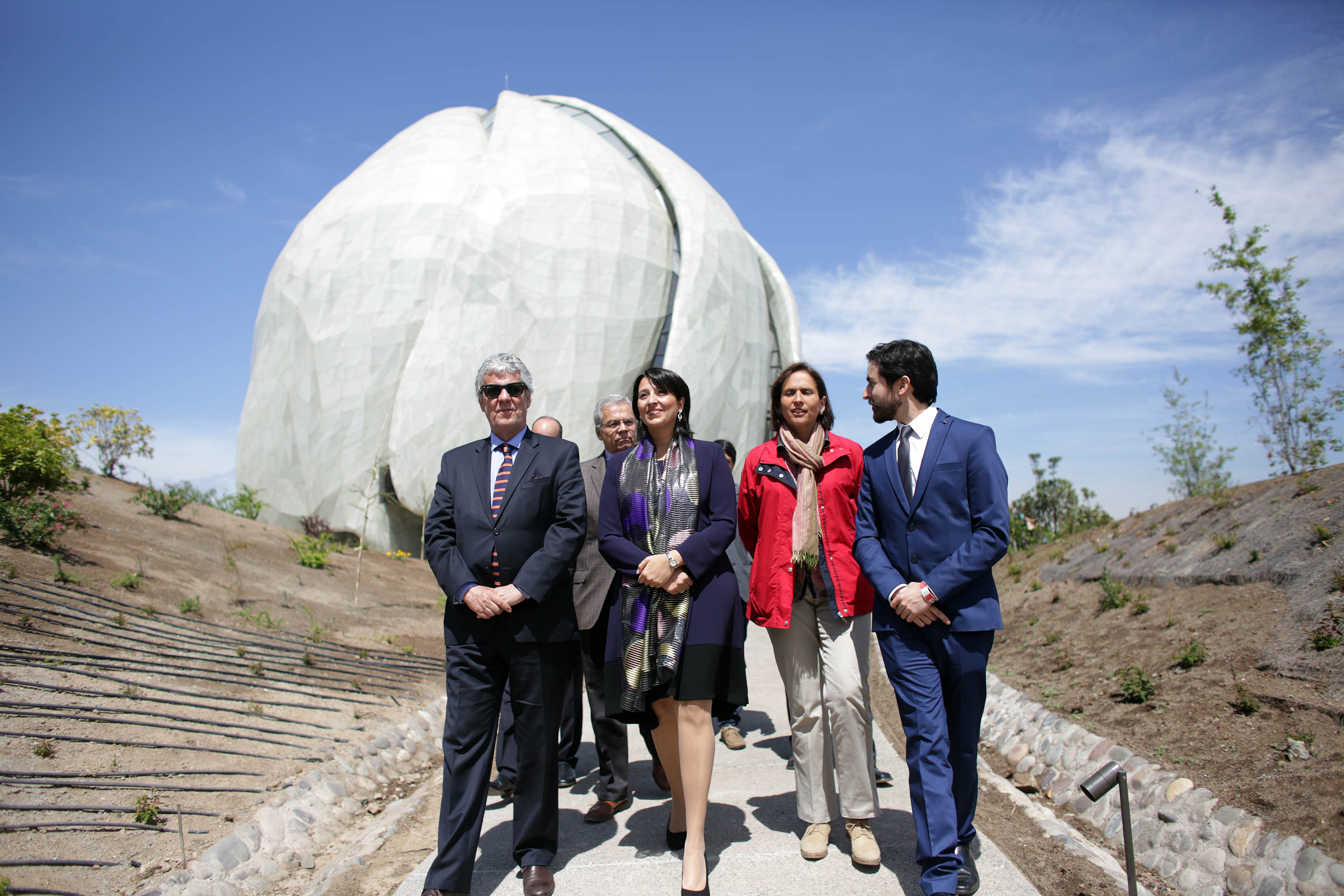 “It is a Temple which makes our landscape a more beautiful one,” he said. “It will become an icon and it will remind us how important it is to find the unity between the city and nature.”
Claudio Orrego, governor of the Santiago metropolitan region, called the Temple a “huge gift” to the citizens of Chile and beyond.
“Today we see the beauty of its creation, together with all the divine and human forces that have made it possible,” said Gov. Orrego. “Santiago will be different from now on because of this beautiful temple that has been given to us… It doesn’t matter what religion we belong to, what creed we profess, our cities are full of the thirst for silence and to transcend.”
 Minister Eyzaguirre and Gov. Orrego were among the some 500 dignitaries, joined by an estimated 5,000 Bahá’ís from 110 countries, who gathered on 13 October 2016 for the Temple’s dedication, reflecting the building’s importance both to Bahá’ís and society at large — as testified by the continuing stream of visitors.
“Since the inauguration of the House of Worship in October, thousands of people of all walks of life, of various religious affiliations and ethnicities have visited the place,” said Eduardo Rioseco, director of the House of Worship.
“A large number of those visitors have come not once but several times, and often when they return they bring their friends and family. Some neighbors are already taking the habit of coming at least weekly, and sometimes even more frequently.”
Mr. Rioseco said the Temple seemed to be providing a special place within the Santiago area, one that gives visitors a “haven for the deepest contemplation on spiritual reality and those foundational questions we all ponder at some point in our lives,” as well as a place for “conversations” on “the nature of the soul, the process of social transformation we can foster, and the spiritual principles that could help us along the way.”
Eighth such Temple worldwide
The House of Worship in Chile is the eighth such Bahá’í Temple to be built, completing a century-long goal of building one such edifice on each inhabited continent or sub-continent.
The first Temple was completed in 1908 in the city of Ishqabad in Russian Turkistan (now Ashgabat, Turkmenistan), but it was later expropriated by the Soviet authorities and ultimately demolished in 1963.
Currently, listed in the approximate order of their completion, continental Bahá’í Houses of Worship exist in Wilmette, Illinois, USA (1953); Kampala, Uganda (1961); Sydney, Australia (1961); Frankfurt, Germany (1964); Panama City, Panama (1972); Apia, Samoa (1984); and New Delhi, India (1986).
 Over time, Bahá’ís hope to build Houses of Worship in every country where they reside, and, ultimately, in every local community.
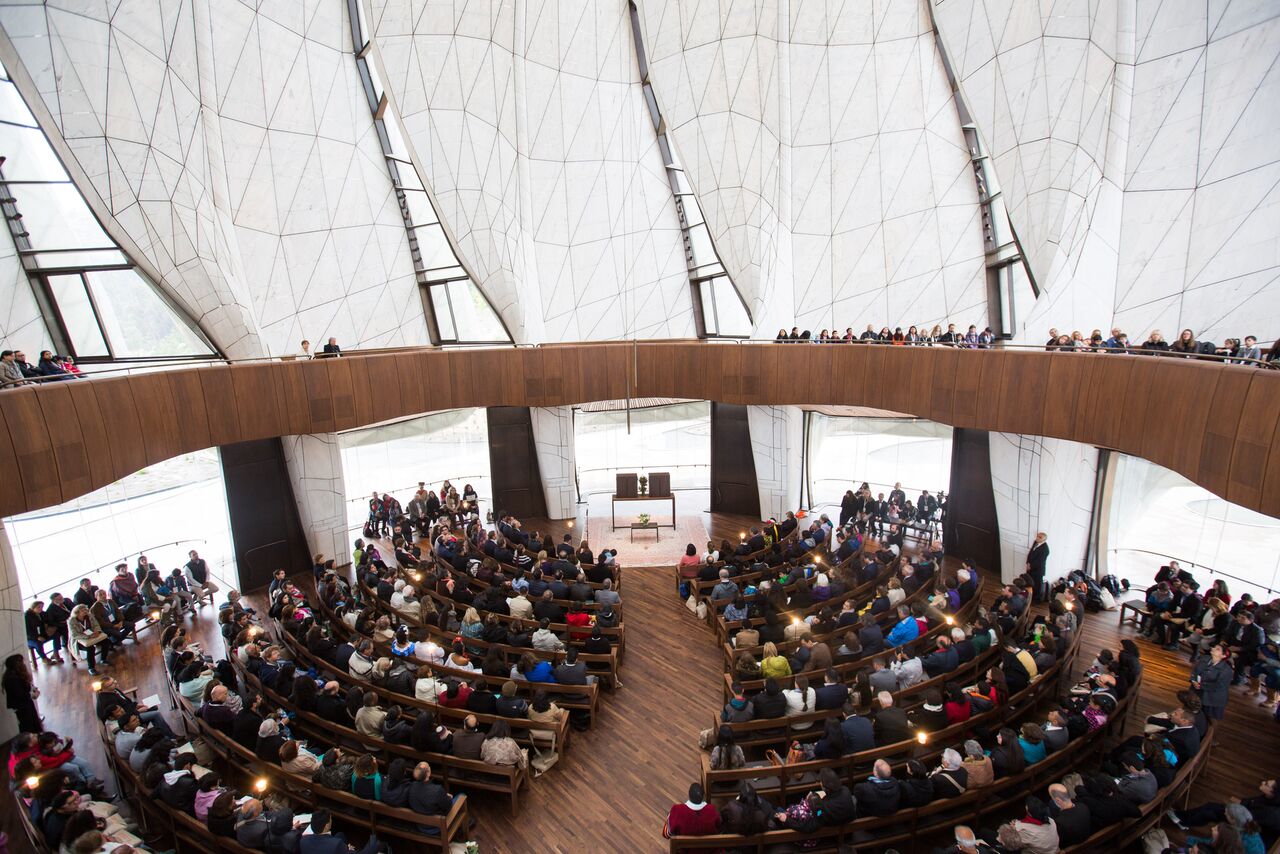
The idea is to create places where people of all backgrounds and beliefs can gather, without ritual, to meditate and to read and sing the sacred scriptures of the world’s religions.
As a symbol of this openness to all, every Bahá’í House of Worship has nine sides and nine doors.
“In that sense, to have a building with nine doors open in all directions is a way of saying that everybody is welcome here,” said Mr. Rioseco.
An architectural challenge
The challenge of working from such a simple set of rules is both frightening and exciting, said Siamak Hariri, the architect responsible for the design.
“It is wide open,” said Mr. Hariri, a partner with the Toronto-based firm of Hariri Pontarini. “The brief is deceptively simple. It is just one room. But there is no clergy, no iconography, and no formal religious service — so what do you grab as a central idea?”
Mr. Hariri noted that so far, each of the seven other Bahá’í Temples has been quite different and distinct from the others.
His goal, then, in approaching the design of the Chile Temple was to start by thinking about how to capture a certain kind of “emotional experience.” He drew inspiration from a passage in the Bahá’í sacred writings that speaks of a house of God in which “all the pillars of the dwelling are ashine with His light.”
From this came the idea that his design should be clad in something like alabaster that would be “alive with light.” And ultimately, that led to the notion of creating a special, translucent glass that would allow the entire structure to glow and radiate.
The second main design theme — that of the spiraling wings that composed the nine sides of the dome — came in pondering the universal form of the spiral. “You see this in photographs of galaxies,” he said, “or the back of a baby’s head. The idea is that the entire Temple is all moving and rotating or torquing around the center,” he said.
His design was accepted by the Bahá’í community in 2003, after an international design competition announced by the National Spiritual Assembly of the Bahá’ís of Chile.
Then came the arduous and difficult task of translating that vision into reality — all within a very limited budget of about $30 million.
“Anybody can do anything with gobs of money. And that is not to say $30 million is pennies. But compared to other budgets for other religious buildings, it is small, and has left people wondering how we did it,” he said.
It took two years, for example, to find the right kind of glass. It had to be super strong, yet relatively inexpensive. Mr. Hariri said they found a company that melts old Pyrex test tubes and petri dishes, and saved money that way. “The whole Temple was built from recycled glass,” he said.
For the interior stone, they found a quarry in Portugal that produced a uniquely translucent type of marble, which was also less costly than traditional alabaster.
“But for me, what is important is to understand that we are talking about a new typology in religious buildings,” said Mr. Hariri. “We don’t know what form this will take in the coming years. It is an evolving, organic process, like the first cathedrals in Christianity, or the first mosques in Islam, or the first synagogues in Judaism.
“We don’t know what form [Bahá’í Temples] will take in the coming years. It is an evolving, organic process, like the first cathedrals in Christianity, or the first mosques in Islam, or the first synagogues in Judaism.
— Siamak Hariri, Architect
“I was trying to express many of the core concepts in terms of worship in the Bahá’í community,” he said. “But we don’t know what forms this will take in the coming years.”
Social and economic activities
Bahá’í Temples are also intended to become community centers where social, humanitarian, educational, and scientific endeavors are ultimately pursued.
“Although in the Bahá’í writings you can find references to some specific dependencies — such as a home for the aged or a hospital — that are to be developed in future, we know that those references are not necessarily comprehensive,” said Mr. Rioseco.
 “So it’s hard to say how this will evolve, but my guess is that it will probably be related to the evolution of the conversations I mentioned before,” said Mr. Rioseco.
He noted, for example, that four years ago a small group, concerned about environmental issues, came to the Temple’s construction site and decided to establish a temporary tree nursery, to help re-establish vegetation around the Temple.
“Gradually the initiative became a more structured project which drew upon volunteers coming now on a weekly basis. Some activities for children and youth started to be fostered in coordination with other educational initiatives that the Bahá’í community has in Santiago and many other places,” he said, adding that now trees from the nursery have been planted in schools and public parks in Peñalolén and other areas of Santiago.
