
Growing recognition that freedom of religion is essential in the effort to prevent violent extremism
- A series of recent international meetings have drawn attention to the increasing recognition of the importance of upholding freedom of religion or belief worldwide.
- Experts gathered at separate meetings in New York, London, and Geneva said the promotion of genuine religious freedom could go far to help counter violent extremism.
- Involving religious leaders in protecting this fundamental human right is seen as critical.
LONDON — With its high arches, ornate chandeliers, and golden-topped columns, the Locarno Suite at the British Foreign and Commonwealth Office embodies the essence of the old-world establishment.
But the ideas presented there at a recent conference reflect the latest thinking about the importance of human rights in the global effort to counter violent extremism.
Held 19–20 October 2016, the conference brought together 50 experts on religious freedom and more than 100 other participants from 38 countries. The goal was to better understand how defending and promoting freedom of religion or belief might build resilience against those who seek to use religion to encourage violence and terrorism.
Of course, some governments around the world have sought to fight terrorism by cracking down on religious expression and freedom. The argument is that by repressing religious differences, hateful ideologies will be subdued.
But experts gathered here and at other recent international conferences say that upholding religious freedom promotes tolerance and inclusivity — and this, in turn, can help to short-circuit ideologies of “the other” that stand at the center of violent extremism.
 “Freedom of religion or belief is fundamental to a successful society,” said Baroness Anelay, the UK’s Minister for Human Rights, in an opening address at the London conference. “It builds resilience against the prejudice, discrimination and persecution that not only prevents a society from achieving its full economic potential but also leaves it vulnerable to extremism.”
A fundamental right
Freedom of Religion or Belief (FoRB) is enshrined in the Universal Declaration of Human Rights, which was adopted by the UN in 1948, and further codified as international law in the International Covenant on Civil and Political Rights (ICCPR).
Yet for many years, FoRB was relegated to the back bench of human rights, behind concerns over protections against torture and freedom from arbitrary arrest or detention.
Increased concern about the role of religion in international affairs is causing many to re-examine the importance of FoRB.
“The issue of freedom of religion or belief, especially in the context of combatting violent extremism, is one of the main issues the world is trying to grapple with today,” said Diane Ala’i, a Representative of the Bahá’í International Community to the United Nations in Geneva, who was an invited speaker at the London event.
“It is driven partly by concern about the rise of Daesh in Syria, and horrors like the Charlie Hebdo attack in Paris. But it is a concern that has been growing for a long time. Part of what is happening is that governments thought secularism was going to resolve all of the problems that stem from religious conflict. But what has happened is that by pushing religion out of the public discourse, a void has been created that has been hijacked by extremists.”
At least two other recent conferences reflected a growing awareness of these trends:
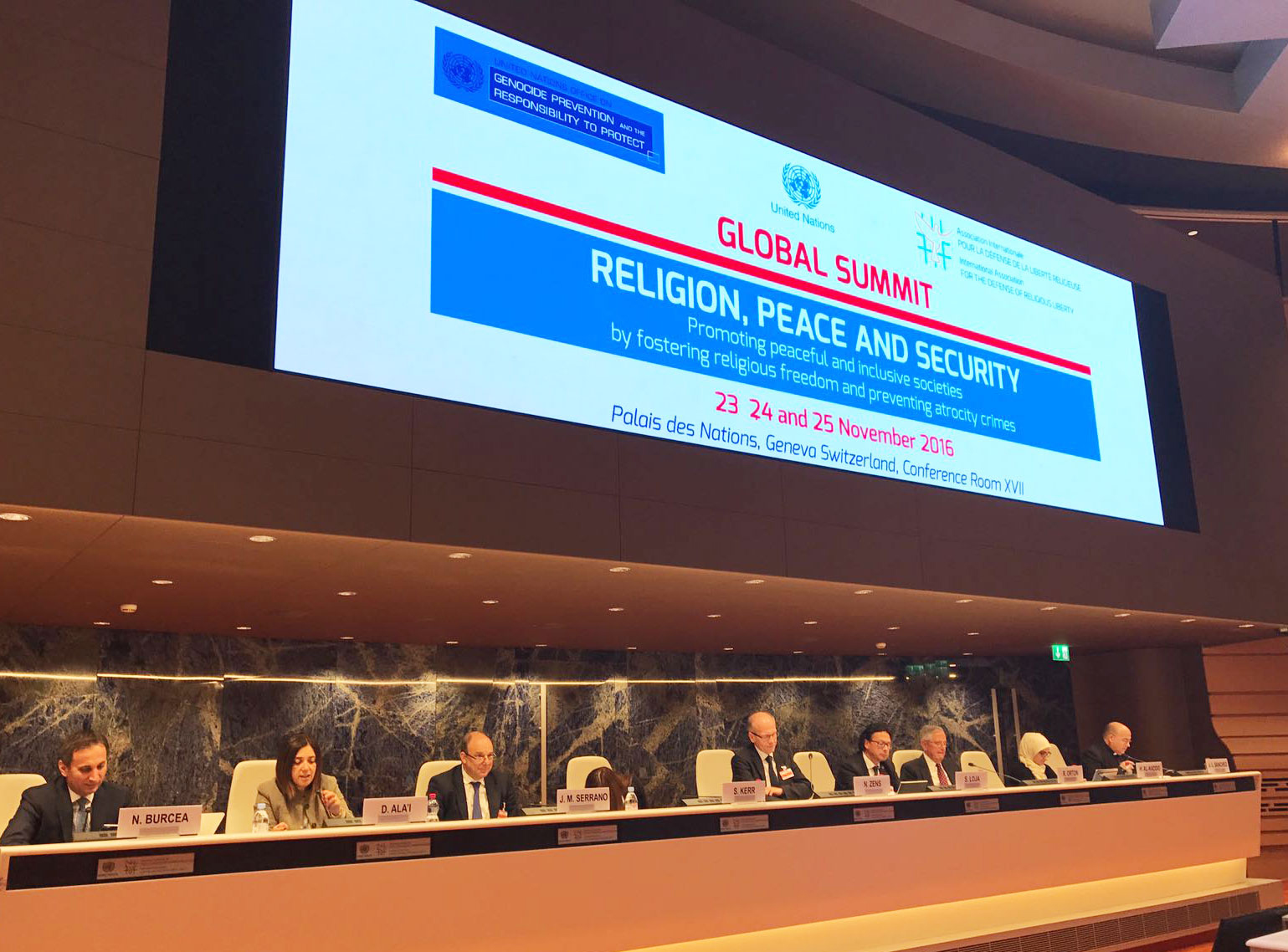
- The Global Summit on Religion, Peace and Security, held 23-25 November 2016 at the Palais des Nations in Geneva, Switzerland. Convened by the United Nations Office on Genocide Prevention and the International Association for the Defense of Religious Liberty, the event sought to discuss how different actors can work together effectively to implement strategies that can foster peace and security.
- A Ministerial Side-Event at the United Nations on “Upholding the Responsibility to Protect: The Role of Religious Leaders in Preventing Atrocity Crimes.” Held 20 September 2016 at the United Nations and organized by the Permanent Observer Mission of the Holy See to the UN, with the UN Office on Prevention Office and the Global Centre for the Responsibility to Protect, the event featured a panel discussion examining the actions religious leaders can take to prevent atrocity crimes and build inclusive societies.
The three events brought forward a number of sub-themes in relation to the connection between FoRB and combatting violent extremism. These included the necessity of more deeply involving religious leaders and the need to think beyond secularism toward a greater recognition of the importance of religion in binding societies together.
Involving religious leaders
 “We sometimes forget here in the West that many of the states troubled by violent extremism are deeply religious societies,” said Sarah Snyder, the Archbishop of Canterbury’s Adviser for Reconciliation, at the London conference. “Religion is not an optional extra, or one dimension among many — it infuses every aspect of life, including the political. The cooperation of religious leaders is vital to the building of inclusive, plural — and peaceful — societies.”
Bani Dugal, the Principal Representative of the Bahá’í International Community to the UN, told those at the UN Ministerial Side-Event in September that religious leaders must reconsider the degree to which their own rhetoric may be fueling extremism — a reconsideration that should include renouncing claims of privileged access to truth or guidance.
“For such claims of divine exclusivity or finality have, in winding their roots around the life of the spirit, been one of the greatest factors in undermining steps toward unity and in promoting hatred and violence,” said Ms. Dugal.
Re-thinking the secular approach
Another emergent sub-theme was a recognition of the limits of secularism, and the concomitant need to more openly recognize the role religion plays in society and in human relations.
“In the past, there was an assumption that secularism could be ‘religion-blind,’ and therefore its promotion could create tolerant societies,” said Nazila Ghanea, an Assistant Professor of International Human Rights Law at the University of Oxford, who spoke at the London event.
“If we think about the challenges of stemming a tide of extremism and terrorism and violence, then pluralism, coexistence, and respecting others despite a diversity of religious beliefs is important. And freedom of religion or belief precisely outlines the implementation of that and provides a framework within a broader context of human rights overall,” said Dr. Ghanea.
“Even states with structures or governments that still uphold a single state religion and that show discrimination against those outside the majority belief are still being plagued by sectarianism — and terrorism,” she added. “And so even their eyes are being opened to the importance of interfaith dialogue and creating understanding.”
